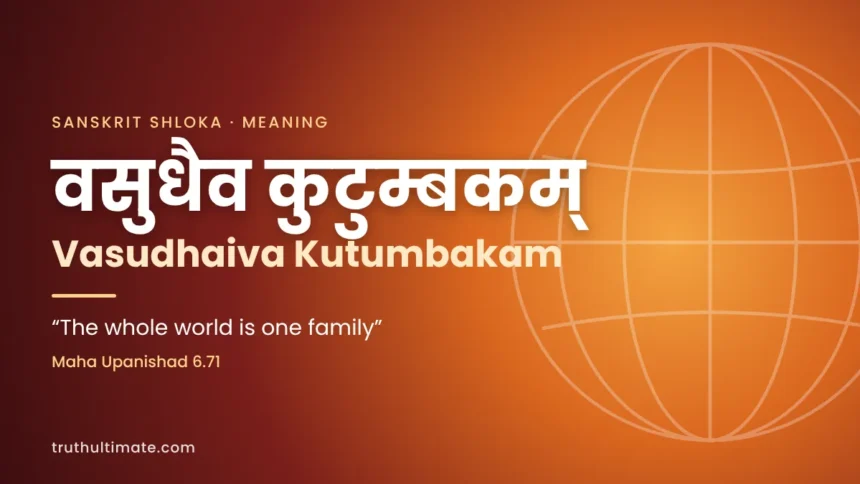
Vasudhaiva Kutumbakam (वसुधैव कुटुम्बकम्) means “the whole earth is one family.” The phrase is the last line of a short Sanskrit verse from the Maha Upanishad (6.71–73), and the same verse appears in the Hitopadesha. In 2023 it became the theme of India’s G20 Presidency as “One Earth, One Family, One Future.” Below you will find the full shloka, a word-by-word meaning, its meaning in English and Hindi, the surprising story behind it, and how to live by it today.
Vasudhaiva Kutumbakam: Quick Answer
- Meaning: The world is one family.
- Source: Maha Upanishad, chapter 6, verses 71–73. The same verse is also found in the Hitopadesha (Book 1, verse 71).
- Full idea: Only narrow-minded people divide others into “mine” and “not mine.” For people with a generous heart, the entire earth is family.
- Modern use: Theme of India’s G20 Presidency in 2023; engraved in the entrance hall of the Parliament of India.
Full Vasudhaiva Kutumbakam Shloka in Sanskrit
अयं निजः परो वेति गणना लघुचेतसाम् ।
उदारचरितानां तु वसुधैव कुटुम्बकम् ॥
Maha Upanishad 6.71Transliteration (Roman):
Ayaṃ nijaḥ paro veti gaṇanā laghucetasām,
udāracaritānāṃ tu vasudhaiva kuṭumbakam.
Simple pronunciation: Ayam nijah paro veti, gananaa laghu-chetasaam; udaara-charitaanaam tu, vasudhaiva kutumbakam.
Word-by-Word Meaning
| Sanskrit word | Meaning |
|---|---|
| अयम् (ayam) | this (person) |
| निजः (nijaḥ) | my own |
| परः (paraḥ) | a stranger, an outsider |
| वा इति (vā iti) | “or” – introducing the thought “this one or that one” |
| गणना (gaṇanā) | counting, calculation, keeping score |
| लघुचेतसाम् (laghucetasām) | of small-minded people |
| उदारचरितानाम् (udāracaritānām) | of people whose conduct is generous and noble |
| तु (tu) | but, on the other hand |
| वसुधा (vasudhā) | the earth (literally “she who holds wealth”) |
| एव (eva) | indeed, itself |
| कुटुम्बकम् (kuṭumbakam) | family, household |
Vasudhaiva is simply vasudhā + eva joined by Sanskrit sandhi, so the phrase literally says: “the earth itself is family.”
Vasudhaiva Kutumbakam Meaning in English
“‘This one belongs to me, that one is an outsider’ – only people with a small mind keep such accounts. For those whose conduct is generous, the whole earth is one family.”
Notice that the verse does not begin with a grand slogan. It begins with a very ordinary habit of the mind: sorting people into “my people” and “other people.” The shloka calls this habit gaṇanā – bookkeeping. A small mind keeps a ledger of who is inside the circle and who is outside. A large heart throws the ledger away.
वसुधैव कुटुम्बकम् का हिंदी अर्थ
“यह मेरा है और वह पराया है – ऐसी गिनती छोटे मन वाले लोग करते हैं। जिनका आचरण उदार है, उनके लिए तो पूरी पृथ्वी ही एक परिवार है।”
सरल शब्दों में: जो व्यक्ति अपने-पराए का भेद छोड़ देता है, वह हर इंसान, हर जीव को अपने परिवार जैसा मानता है। यही वसुधैव कुटुम्बकम् का भाव है।
Vasudhaiva Kutumbakam Is From Which Book?
The verse is best known from the Maha Upanishad, a minor Upanishad, where it appears in chapter 6 (verses 71–73). It also appears, word for word, in two famous collections of fables – the Hitopadesha (compiled by Narayana Pandita, around the 12th century) and versions of the Panchatantra. Indian thinkers have quoted it for centuries as one of the clearest expressions of universal kinship.
A common confusion: the phrase is not from the Bhagavad Gita, although the Gita teaches a similar vision of seeing the same Self in all beings (for example, Gita 6.29).
The context in the Maha Upanishad
In the Maha Upanishad, the verse is part of a teaching about the inner state of a free, realised person. Such a person is described as calm, unattached and without the sense of “I” and “mine.” Seeing the whole world as family is presented as a natural result of this inner freedom – not as a rule imposed from outside. In other words, the Upanishad says: when the walls inside you fall, the walls between you and others fall too.
The Surprising Story Behind Vasudhaiva Kutumbakam (Hitopadesha)
Many people are surprised to learn that in the Hitopadesha this noble verse is spoken by a cunning jackal. The story, from the first book on “Winning Friends,” goes roughly like this:
- A deer and a crow are old, trusted friends.
- A hungry jackal sees the healthy deer and decides to win its trust first, so that it can eat it later.
- When the crow asks the deer, “Who is this new friend? Do you really know him?”, the jackal replies with this very shloka: only small-minded creatures divide others into “own” and “stranger”; for the large-hearted, the world is one family.
- The deer is charmed and accepts the jackal. Later the jackal leads the deer into a farmer’s trap.
- In the end, the wise crow uses a clever trick to free the deer, and the jackal gets what it deserves.
What does this teach? The story does not reject the ideal. It warns that a beautiful ideal can be misused by someone with selfish motives. Real universal love goes together with viveka – clear discrimination. You can treat the whole world as family and still use common sense about whom you trust. The Upanishad gives the ideal; the fable adds the wisdom to protect it.
Vasudhaiva Kutumbakam in Modern India
- Parliament of India: The verse is engraved in the entrance hall of the Parliament of India.
- G20 Presidency, 2023: India chose “Vasudhaiva Kutumbakam – One Earth, One Family, One Future” as the theme of its G20 Presidency, and the New Delhi Leaders’ Declaration (September 2023) opened with that line.
- International Day of Yoga, 2023: The theme was “Yoga for Vasudhaiva Kutumbakam.”
- Diplomacy: Indian leaders across decades have used the phrase to describe India’s outlook towards the world.
How to Live Vasudhaiva Kutumbakam in Daily Life
A shloka becomes alive only when it changes how we act. Here are five simple practices:
- Catch the “ledger” in your mind. Notice when you quickly label someone as “one of us” or “not one of us” – by language, caste, religion, region or status. Just noticing weakens the habit.
- Widen your circle one step at a time. Begin with neighbours, colleagues and the people who serve you every day – the security guard, the delivery person, the house help. Learn their names.
- Include all life. Kutumbakam is not only about humans. Caring for animals, water and trees is part of treating the earth as family.
- Practise loving-kindness. Spend a few minutes wishing well to yourself, your family, a stranger and even a difficult person. This is the same spirit as Metta Bhavana.
- Love with wisdom. Remember the deer and the jackal. Open-heartedness does not mean ignoring warning signs.
Related Shlokas With the Same Spirit
- Sarve Bhavantu Sukhinah – may all beings be happy.
- Bhavatu Sabba Mangalam – the Buddhist blessing for the welfare of all.
- Atithi Devo Bhava – the guest is like God.
- Ahimsa Paramo Dharma – non-violence is the highest dharma.
- Satyameva Jayate – truth alone triumphs.
- Top 20 Sanskrit Shlokas With Meaning for Daily Life
Frequently Asked Questions
What is the meaning of Vasudhaiva Kutumbakam?
It means “the world is one family.” Vasudhā is the earth, eva means indeed, and kuṭumbakam means family.
Vasudhaiva Kutumbakam is taken from which scripture?
It comes from the Maha Upanishad (6.71–73). The same verse also appears in the Hitopadesha and in versions of the Panchatantra.
Is Vasudhaiva Kutumbakam in the Bhagavad Gita?
No. The phrase is not in the Bhagavad Gita, although the Gita expresses a similar idea of seeing oneself in all beings.
Why was Vasudhaiva Kutumbakam the G20 theme?
India used it for its 2023 G20 Presidency as “One Earth, One Family, One Future” to express the idea that global problems like climate change, health and development can only be solved together.
Who said Vasudhaiva Kutumbakam first?
No single author is known. The verse belongs to the Upanishadic and subhashita (wise saying) tradition and was later quoted in the Hitopadesha, which was compiled by Narayana Pandita.
Conclusion
Vasudhaiva Kutumbakam is a verse of just two short lines, yet it asks for the biggest change a human being can make: to stop keeping score of who belongs. The Maha Upanishad shows it as the natural state of a free mind, the Hitopadesha reminds us to hold it with wisdom, and modern India has offered it to the world as a shared vision. The next time you meet a stranger, try seeing them through this shloka – as a member of your own large family.