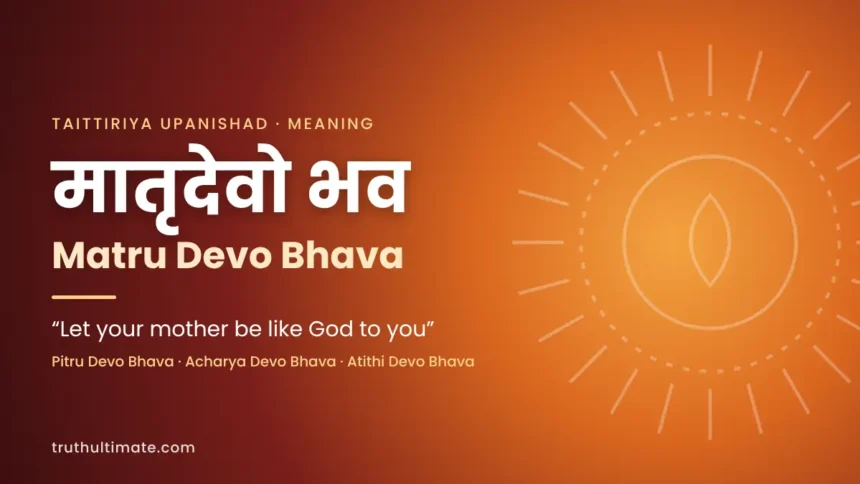
Matru Devo Bhava (मातृदेवो भव) means “let your mother be like God to you.” These three Sanskrit words open one of the most loved teachings of ancient India, from the Taittiriya Upanishad (1.11.2). The full line continues: Pitru Devo Bhava, Acharya Devo Bhava, Atithi Devo Bhava – treat your father, your teacher and your guest as divine too. Below you will find the complete shloka, its word-by-word meaning, its meaning in English and Hindi, the beautiful context in which it was spoken, and how to live it today.
Matru Devo Bhava: Quick Answer
- Meaning: Be one for whom the mother is a deity – honour, serve and respect your mother as you would honour God.
- Source: Taittiriya Upanishad, Shiksha Valli, chapter 11, verse 2 (Krishna Yajurveda).
- Full line: Matru Devo Bhava, Pitru Devo Bhava, Acharya Devo Bhava, Atithi Devo Bhava.
- Spoken by: A teacher (acharya) to his students on the day they finished their studies and left the gurukula – an ancient convocation address.
Full Matru Devo Bhava Shloka in Sanskrit
देवपितृकार्याभ्यां न प्रमदितव्यम् ।
मातृदेवो भव । पितृदेवो भव ।
आचार्यदेवो भव । अतिथिदेवो भव ।
यान्यनवद्यानि कर्माणि । तानि सेवितव्यानि । नो इतराणि ।
यान्यस्माकं सुचरितानि । तानि त्वयोपास्यानि । नो इतराणि ॥
Taittiriya Upanishad 1.11.2Transliteration:
Deva-pitṛ-kāryābhyāṃ na pramaditavyam.
Mātṛdevo bhava. Pitṛdevo bhava.
Ācāryadevo bhava. Atithidevo bhava.
Yāny anavadyāni karmāṇi, tāni sevitavyāni, no itarāṇi.
Yāny asmākaṃ sucaritāni, tāni tvayopāsyāni, no itarāṇi.
Simple pronunciation: Maa-tru de-vo bha-va, pi-tru de-vo bha-va, aa-chaar-ya de-vo bha-va, a-ti-thi de-vo bha-va.
Word-by-Word Meaning
| Sanskrit | Meaning |
|---|---|
| मातृ (mātṛ) | mother |
| पितृ (pitṛ) | father |
| आचार्य (ācārya) | teacher, guru |
| अतिथि (atithi) | guest – literally “one who comes without a fixed date” |
| देवः (devaḥ) | god, a divine being, one worthy of reverence |
| भव (bhava) | be, become (an instruction) |
| अनवद्यानि कर्माणि (anavadyāni karmāṇi) | blameless, faultless actions |
| सेवितव्यानि (sevitavyāni) | should be practised |
| नो इतराणि (no itarāṇi) | not the others |
| सुचरितानि (sucaritāni) | good conduct, virtuous deeds |
Mātṛdevo is a single Sanskrit compound (a bahuvrīhi). So mātṛdevo bhava does not simply say “mother is God”; it says “be a person for whom the mother is God.” The instruction is about who you become.
Matru Devo Bhava Meaning in English
“Never neglect your duties towards the gods and the ancestors. Be one who regards the mother as divine. Be one who regards the father as divine. Be one who regards the teacher as divine. Be one who regards the guest as divine. Do only those actions that are free from blame, and no others. Follow only what is good in our own conduct, and nothing else.”
मातृदेवो भव का हिंदी अर्थ
- मातृदेवो भव – माता को देवता के समान मानो।
- पितृदेवो भव – पिता को देवता के समान मानो।
- आचार्यदेवो भव – गुरु (शिक्षक) को देवता के समान मानो।
- अतिथिदेवो भव – अतिथि को देवता के समान मानो।
पूरा भाव: “देवताओं और पितरों के प्रति अपने कर्तव्य में कभी आलस मत करो। माता, पिता, गुरु और अतिथि को देवता मानकर उनका सम्मान और सेवा करो। केवल वही कर्म करो जो निर्दोष हों, दूसरे नहीं। हमारे (गुरुओं के) भी केवल अच्छे आचरण को अपनाओ, बाकी को नहीं।”
Where Does Matru Devo Bhava Come From?
Matru Devo Bhava comes from the Taittiriya Upanishad, which belongs to the Krishna (Black) Yajurveda. The Upanishad has three parts – Shiksha Valli, Brahmananda Valli and Bhrigu Valli. Our verse is in the 11th section (anuvaka) of the Shiksha Valli, the part about learning and discipline.
An ancient convocation speech
The whole of chapter 1.11 is the teacher’s parting advice to students who have completed their Vedic studies and are about to go home and start family life. It begins with the famous words Satyam Vada, Dharmam Chara – “speak the truth, live by dharma” – and then gives a series of short instructions. Matru Devo Bhava is one of them. The philosopher Dr S. Radhakrishnan pointed out that this passage is a convocation address, and that it is still observed in the convocation at Banaras Hindu University.
Think about the moment: young people, after years of study, are stepping into the world. Of all the things a teacher could say, he reminds them first of the people who gave them life, raised them and taught them. That order says a lot about what the tradition valued.
Why Is the Mother Mentioned First?
The list begins with the mother, then the father, then the teacher, then the guest. Traditional teachers explain this order in a simple way: the mother is our first world and our first teacher. She gives us life, language and our earliest sense of love and safety. The father provides and protects, the acharya opens the door to knowledge, and the guest tests whether all that learning has made us generous. Each circle is a little wider than the one before – from the home, to the school, to the stranger at the door.
What Does “Treat as God” Really Mean?
The Upanishad is not asking us to build temples for our parents. “Deva” here points to an attitude: reverence, gratitude and willing service. Treating someone as divine means:
- speaking to them with respect, even when we disagree;
- remembering what they have given us and expressing thanks;
- caring for their needs, especially in old age or illness;
- not taking them for granted simply because they are always there.
The Line Most People Miss: “Follow Only Our Good Deeds”
Right after Matru Devo Bhava, the teacher says something remarkable: “Follow only what is good in our conduct, and nothing else.” The same humble teacher who asks students to honour parents and gurus also tells them not to copy blindly. Respect is not the same as imitation. You can treat your mother, father and teacher as divine and still use your own judgement about right and wrong. This balance – deep reverence with clear thinking – is what makes the teaching so wise.
How to Live Matru Devo Bhava Today
- Call or visit regularly. In busy lives, a daily phone call to parents is a simple form of seva.
- Listen fully. Give your mother and father your attention without checking your phone. Being heard is a form of respect.
- Say thank you out loud. Most of us feel gratitude but rarely express it. Tell them specifically what you are grateful for.
- Share the load. Help with household work, health check-ups, paperwork and other practical needs, especially as they grow older.
- Honour teachers and guests too. Stay in touch with a teacher who shaped you, and welcome visitors warmly – the full verse asks for all four.
Related Shlokas
- Atithi Devo Bhava – the guest is like God (from the same verse).
- Satyam Vada Dharmam Chara – the opening of the same convocation address.
- Janani Janmabhoomischa Swargadapi Gariyasi – mother and motherland are greater than heaven.
- Guru Brahma Guru Vishnu – the famous prayer to the teacher.
- Vasudhaiva Kutumbakam – the whole world is one family.
Frequently Asked Questions
What is the meaning of Matru Devo Bhava?
It means “be one for whom the mother is God” – in simple words, respect and serve your mother as you would honour the divine.
Matru Devo Bhava is from which Upanishad?
It is from the Taittiriya Upanishad, Shiksha Valli, chapter 11, verse 2.
What is the full Matru Devo Bhava shloka?
Matru Devo Bhava, Pitru Devo Bhava, Acharya Devo Bhava, Atithi Devo Bhava – treat your mother, father, teacher and guest as divine. It is followed by the advice to do only blameless actions and to follow only the good conduct of one’s elders.
Is Matru Devo Bhava from the Bhagavad Gita?
No. It is from the Taittiriya Upanishad, not the Bhagavad Gita.
Who said Matru Devo Bhava?
In the Upanishad, these words are spoken by an acharya (teacher) to his students at the end of their education, as parting advice for life.
Conclusion
Matru Devo Bhava is short enough for a child to remember and deep enough to guide a whole life. Thousands of years ago, a teacher sent his students into the world with this reminder: before you chase success, honour the mother who gave you life, the father who raised you, the teacher who opened your mind and the guest who arrives at your door. If we can treat these four as divine – with love, gratitude and clear thinking – we have understood the heart of Indian culture.