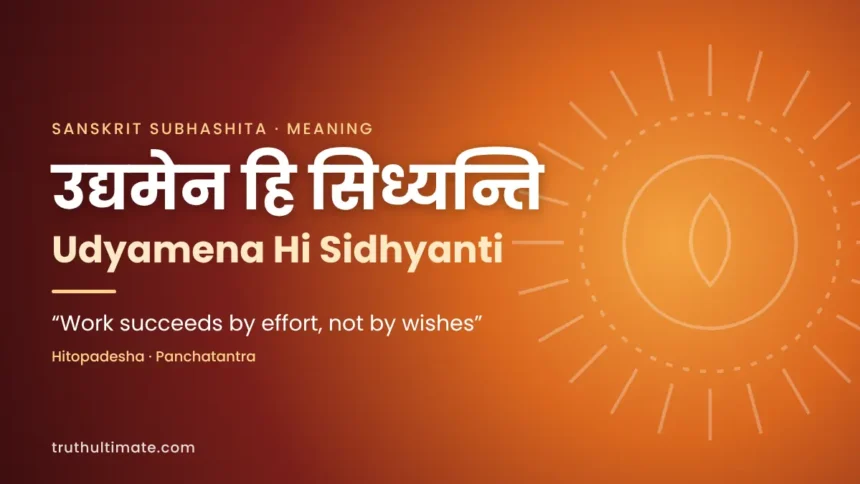
Udyamena Hi Sidhyanti (उद्यमेन हि सिध्यन्ति) means “work gets done only through effort.” It is the opening of one of the most famous Sanskrit subhashitas, the one that ends with the picture of a sleeping lion: even the king of the forest does not get food if he only lies there waiting. Students learn it in school, parents quote it at home, and it still works as one of the shortest lessons on hard work ever written. Here is the full shloka, its word-by-word meaning, its meaning in English and Hindi, where it comes from and how to use it in daily life.
Udyamena Hi Sidhyanti: Quick Answer
- Meaning: Tasks are accomplished by effort, not by mere wishes. Deer do not walk into the mouth of a sleeping lion.
- Source: A popular subhashita found in the fable collections of ancient India – the Hitopadesha and the Panchatantra.
- Lesson: Talent and dreams are not enough. Results come to those who act.
Full Udyamena Hi Sidhyanti Shloka in Sanskrit
उद्यमेन हि सिध्यन्ति कार्याणि न मनोरथैः ।
न हि सुप्तस्य सिंहस्य प्रविशन्ति मुखे मृगाः ॥
Transliteration:
Udyamena hi sidhyanti kāryāṇi na manorathaiḥ,
na hi suptasya siṃhasya praviśanti mukhe mṛgāḥ.
Simple pronunciation: Ud-ya-me-na hi sid-dhyan-ti, kaar-yaa-ni na ma-no-ra-thaih; na hi sup-tas-ya sim-has-ya, pra-vi-shan-ti mu-khe mri-gaah.
You may also see the first words written as Udyamenaiva sidhyanti (“only by effort”), or the second line as na hi suptasya siṃhasya viśanti vadane mṛgāḥ. The wording changes slightly between editions, but the meaning is exactly the same.
Word-by-Word Meaning
| Sanskrit | Meaning |
|---|---|
| उद्यमेन (udyamena) | by effort, by diligent work |
| हि (hi) | indeed, only (adds emphasis) |
| सिध्यन्ति (sidhyanti) | are accomplished, succeed |
| कार्याणि (kāryāṇi) | tasks, goals, works |
| न (na) | not |
| मनोरथैः (manorathaiḥ) | by wishes, by day-dreams (literally “chariots of the mind”) |
| सुप्तस्य (suptasya) | of one who is sleeping |
| सिंहस्य (siṃhasya) | of a lion |
| प्रविशन्ति (praviśanti) | enter |
| मुखे (mukhe) | into the mouth |
| मृगाः (mṛgāḥ) | deer, animals (the prey) |
A lovely detail hides in the word manoratha. It is made of manas (mind) and ratha (chariot). A wish is a chariot that travels only inside the mind. It can go anywhere, but it never actually arrives. Effort is what turns that imaginary journey into a real one.
Udyamena Hi Sidhyanti Meaning in English
“Tasks are accomplished only through effort, not by merely wishing for them. Deer do not enter the mouth of a sleeping lion.”
The choice of animal is clever. The verse could have used a lazy man as its example. Instead it uses the lion – the strongest, most respected animal in the forest. The message is sharp: if even a lion must get up and hunt, no one is so gifted that results will come to them without work. Strength, intelligence and good luck are only possibilities. Action is what turns them into results.
उद्यमेन हि सिध्यन्ति का हिंदी अर्थ
“कोई भी काम परिश्रम (उद्यम) करने से ही पूरा होता है, केवल मन में इच्छा करने से नहीं। जैसे सोए हुए शेर के मुँह में हिरण अपने आप नहीं आ जाते।”
सरल शब्दों में: शेर जंगल का राजा है, फिर भी उसे भोजन के लिए शिकार करना पड़ता है। उसी तरह, सपने देखना अच्छा है, पर उन्हें पूरा करने के लिए मेहनत करनी ही पड़ती है।
Where Does This Shloka Come From?
Udyamena Hi Sidhyanti is a subhashita – a “well-said” verse of practical wisdom. It is best known from the ancient Indian fable collections. A version of it appears in the Panchatantra, the famous book of animal stories traditionally credited to Vishnu Sharma, and it is widely quoted from the Hitopadesha of Narayana Pandita, which retells many Panchatantra stories for young princes. Because it is so short and memorable, the verse also travelled into collections of subhashitas and into school textbooks across India.
Its companion verses on effort
The introduction of the Hitopadesha contains several verses that make the same point in different ways. Two of them are worth knowing:
- न दैवम् अपि संचिन्त्य त्यजेद् उद्योगम् आत्मनः । अनुद्योगेन तैलानि तिलेभ्यो नाप्तुम् अर्हति ॥ – Do not give up your own effort by thinking only of fate. Without effort, you cannot even get oil out of sesame seeds.
- उद्योगिनं पुरुषसिंहम् उपैति लक्ष्मीः … – Prosperity comes to the hard-working person who is like a lion among men; only the weak say “it will come if destiny gives it.” Put fate aside, use your own strength, and if you still fail after real effort, there is no blame.
Read together, these verses do not deny luck or destiny. They simply say: your part of the deal is effort, and that part is fully in your hands.
Effort vs. Wishing: What the Shloka Really Teaches
The verse is not against dreams. A manoratha is where every goal begins – you must first imagine the exam result, the business or the healthy body you want. The problem starts when the wish replaces the work. Three simple lessons follow from the shloka:
- Talent is not a guarantee. The lion has every natural advantage and still goes hungry if it sleeps. Ability only matters when it is used.
- Opportunities do not walk in by themselves. The deer are out there, but the lion has to go to them. In the same way, jobs, clients and knowledge have to be pursued.
- Effort is the part you control. You cannot control every result, but you can control whether you got up and tried. That is a very freeing idea.
This idea fits closely with the Bhagavad Gita’s teaching on action, which you can read about in our article on Karmanye Vadhikaraste.
How to Apply Udyamena Hi Sidhyanti in Daily Life
- Turn every wish into one small action today. Want to learn a language? Learn ten words today. A wish with a first step is no longer just a manoratha.
- Write the goal, then the work. Next to each goal, write the daily or weekly effort it needs. This makes the “hunt” visible.
- Beat procrastination with a timer. Work for 25 minutes without distraction. Starting is the hardest part; the lion only has to get up once.
- Stop waiting for perfect conditions. The deer will not line up neatly. Begin with what you have.
- Review effort, not just results. At the end of the week, ask “Did I put in the work?” before asking “Did I succeed?”
For students, this shloka is a great line to write on the first page of a notebook. For anyone feeling stuck, it is a gentle push: get up, and go to your goal.
Related Shlokas
- Swayameva Mrugendrata – another lion verse: the lion becomes king by its own strength.
- Karmanye Vadhikaraste – you have a right to your actions, not to their fruits.
- Yogah Karmasu Kaushalam – yoga is skill in action.
- Vidya Dadati Vinayam – knowledge gives humility.
- How to Avoid Procrastination – practical tips to start working.
Frequently Asked Questions
What is the meaning of Udyamena Hi Sidhyanti?
It means “tasks are accomplished only through effort.” The full verse adds that deer do not walk into the mouth of a sleeping lion – so results need action, not just wishes.
Udyamena Hi Sidhyanti is from which book?
It is a well-known subhashita found in the Panchatantra and widely quoted from the Hitopadesha, the two great collections of Indian fables.
What is the full shloka?
Udyamena hi sidhyanti kāryāṇi na manorathaiḥ, na hi suptasya siṃhasya praviśanti mukhe mṛgāḥ.
Why is a lion used as the example?
Because the lion is the strongest animal. If even the king of the forest must hunt for its food, then nobody – however talented – can succeed without effort.
Is Udyamena Hi Sidhyanti from the Bhagavad Gita?
No. It is a subhashita from the fable tradition, not a verse of the Bhagavad Gita, although the Gita also strongly encourages action.
Conclusion
Udyamena Hi Sidhyanti is just two lines long, but it carries a lesson every generation needs to hear again: dreams start the journey, effort completes it. The sleeping lion stays hungry, no matter how powerful it is. So keep your manorathas – your big wishes – and then do what the lion must do every day: get up and go after them.